Why Garowe Online Named the President of Puntland “Person of the Year”
-
 GAROWE ONLINE
- Posted On 18-12-2025, 08:08AM
Sometimes, a single decision carries more weight than years of speeches. And sometimes, true leadership is defined by what one does when danger arises—not when everything is calm.
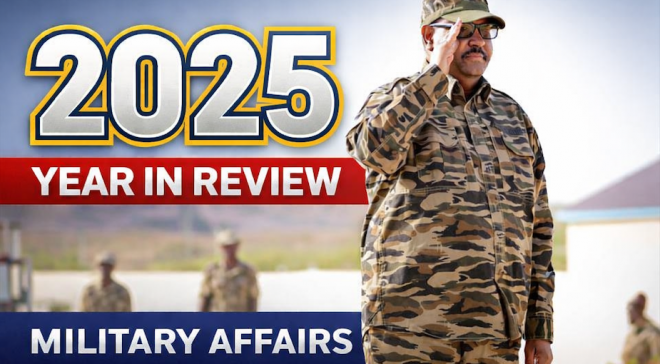
This year, Garowe Online decided to recognize the President of the Puntland State, Said Abdullahi Deni, as Person of the Year. This decision was not based on personality, party politics, or the usual leadership debates. Rather, it stemmed from one clear factor: the leadership he demonstrated during the direct war against the terrorist group ISIS—a war that profoundly affected the security, direction, and future of Puntland.
This designation reflects a year in which Puntland faced one of the gravest threats since its establishment. ISIS, which had long been hiding in the AL-Miskad mountains of Bari region, attempted to establish a base there to organize terrorist operations and seize strategic cities in Bari, particularly Bosaso, Puntland’s commercial hub.
War Preparation: Before the First Shot Was Fired
The war was not entered hastily or emotionally. It was preceded by a prolonged period of preparation: military mobilization and readiness, security risk assessments, and psychological preparation of the public. The President reached the conclusion that the ISIS threat could not be contained through rhetoric or fragmented operations, but required a full-scale military approach.
The suicide attack in Dharjaale—intended by ISIS to break this preparation—became the dividing line between two phases: one in which the terrorists continued their plans, and another in which they openly confronted an organized military force. Rather than weakening Puntland’s resolve, the attack accelerated military operations.
AL-Miskad: A Battle That Shifted the Balance of Power
During the operations, Puntland forces captured all major ISIS bases in the Calmiskaad mountains, removing the pressure the group had imposed on civilians, traders, and economic activity in Bari region.
When the War Became an International Issue
Puntland’s war against ISIS did not remain confined within its borders. The progress of operations, the scale of liberated territory, and the threat ISIS posed to trade routes and the security of the Red Sea and Gulf of Aden drew international attention, particularly from the United States and the United Arab Emirates.
These two countries played a visible role in providing strategic support to Puntland—including intelligence, technical assistance, training, and security coordination—to ensure Puntland forces could dismantle ISIS in an organized and sustainable manner. This support came at a critical phase of the war, when difficult decisions were required, and it significantly boosted operational confidence and capability.
This security coordination clearly demonstrated that the conflict was not merely a regional matter, but an international security issue, placing Puntland at the forefront of counterterrorism efforts in the Horn of Africa.
The Reason for the Designation
Garowe Online’s reason for naming President Deni as Person of the Year is simple yet weighty: he made a leadership decision at a time of danger and fulfilled his responsibility with dedication. The war against ISIS was not an ordinary operation; it was a test of Puntland’s security existence and public trust in leadership.
But Person of the Year Does Not Mean All Tasks Are Complete
As is often the case with recognized leaders, the designation is not a conclusion but the beginning of a new chapter. Once a security threat is defeated, the question becomes: how can that victory be transformed into a complete democratic system, transparent institutions, and a fully functioning government?
Puntland still faces challenges related to:
- completing the electoral system,
- transparency of public institutions,
- rebuilding administration in areas liberated from terrorism,
- and converting security gains into economic and social development.
Naming a Person of the Year does not erase these questions; it simply highlights the reality that leadership is judged by action—and that the same leadership is expected to do even more in the unfinished work ahead.
GAROWE ONLINE