UN Supports Nationwide Labour Rights Education Campaign Led by Somali Trade Unions
-
 FESTU Press Release
- Posted On 03-03-2026, 06:23PM
The Federation of Somali Trade Unions (FESTU), with the support of the United Nations (UN), has rolled out a nationwide labour rights education campaign aimed at enabling workers to understand, reclaim and defend their labour rights while ensuring effective implementation of Somalia's newly adopted Labour Code, which entered into force after 52 years without comprehensive reform.
The new Labour Code was developed through sustained social dialogue and negotiations among Somalia’s tripartite constituencies: the Ministry of Labour and Social Affairs (MOLSA), the Somali Chamber of Commerce and Industry (SCCI) and FESTU, with technical and financial support from the International Labour Organization (ILO). The draft text was agreed collectively before being submitted to the Council of Ministers and subsequently approved by both houses of the Federal Parliament of Somalia, after which the President of the Federal Republic of Somalia assented to it and signed it into law.
Under the ambit of FESTU and its 12 affiliated national unions, organised labour campaigned relentlessly for more than 10 years to secure this reform in line with international labour standards and Somalia's international human rights obligations. FESTU described the reform as a historic affirmation that labour rights are human rights and that the rights of working people cannot be ignored.
“For 52 years, Somalia’s working women and men were governed by an outdated and unjust legal framework that no longer reflected the realities of modern workplaces and that was inconsistent with the Constitution of Somalia and Somalia’s international human rights obligations, including global labour standards,” said Omar Faruk Osman, General Secretary of FESTU. “It is on this basis that our persistent efforts delivered this new Labour Code. But any law is only meaningful when the people concerned, predominantly the workers, understand the rights enshrined in it, claim their rights and stand ready to defend them. This law confirms that dignity at work, protection from exploitation and freedom from harassment are fundamental human rights.”
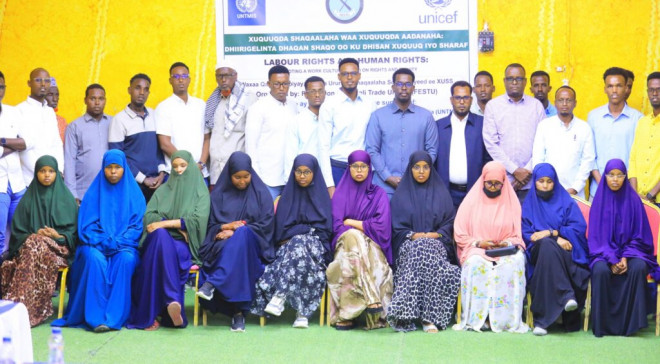
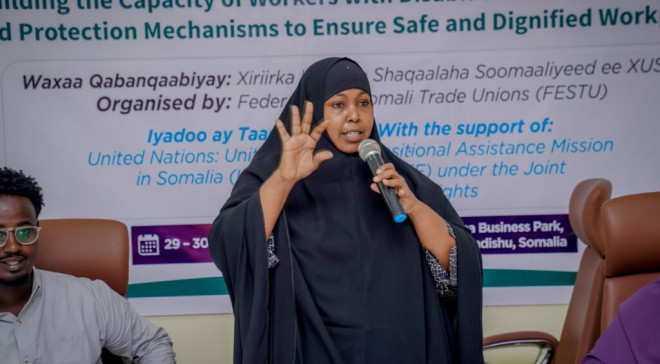
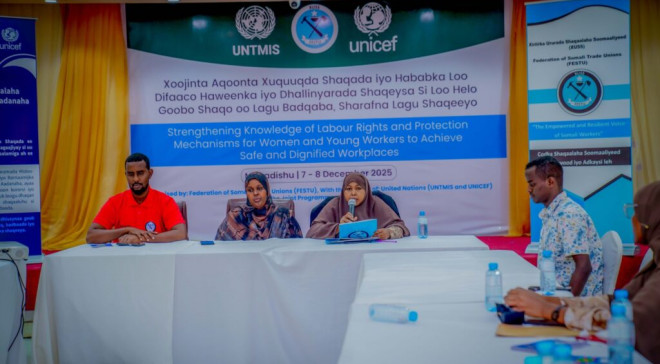
Between October and December 2025, FESTU implemented the Labour Rights Education Programme in partnership with the United Nations Transitional Mission in Somalia (UNTMIS) and the United Nations Children’s Fund (UNICEF) under the Joint Programme on Human Rights Phase II. The initiative focused on strengthening workers’ capacity to demand and defend labour rights across Mogadishu and the Federal Member States, working closely with its 12 affiliated unions to ensure nationwide outreach and sustainability.
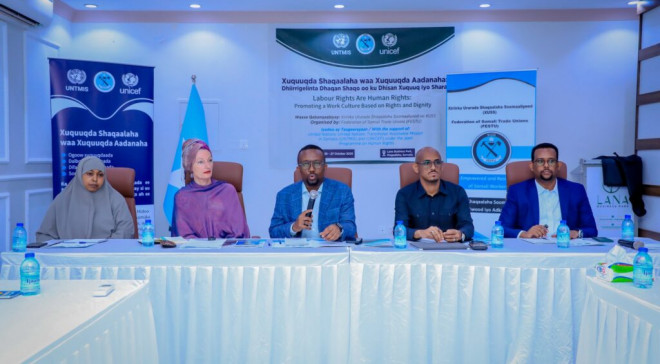
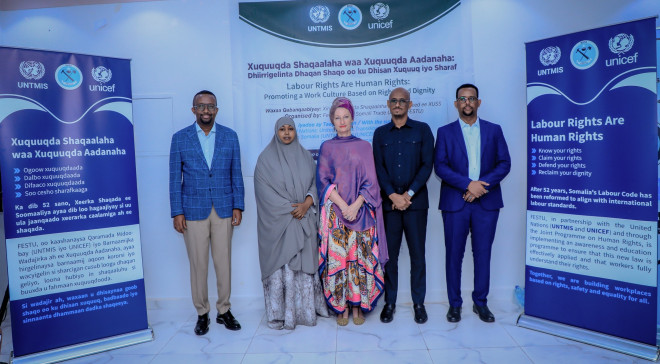
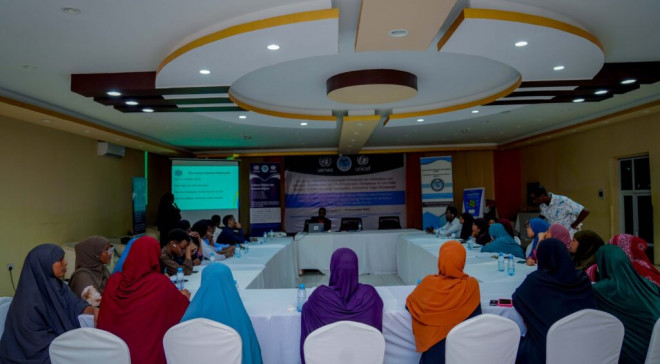
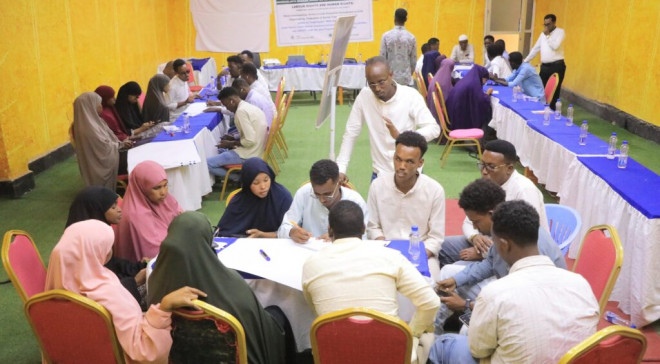
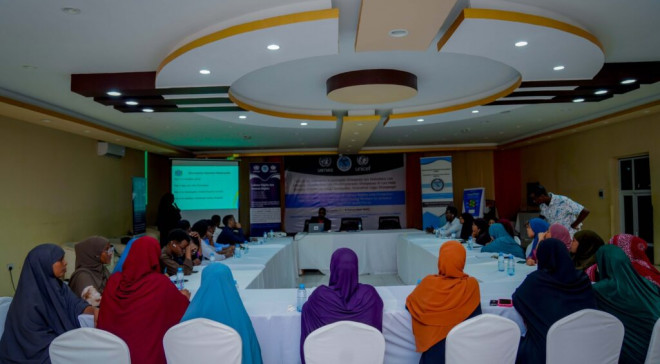
The program began with a national launch event and workshop in Mogadishu, in the presence of officials from the UN, trade unions and the Federal Government of Somalia. It was followed by activities in Baidoa in South West State, Dhusamareb in Galmudug State; and Beledweyne in Hirshabelle State, where workers from different economic sectors were educated on the new legal framework governing the world of work in Somalia.
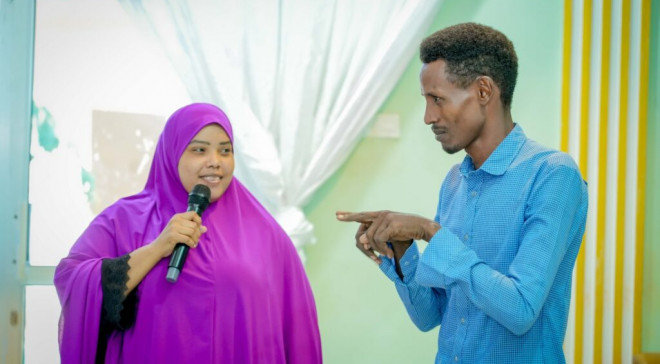
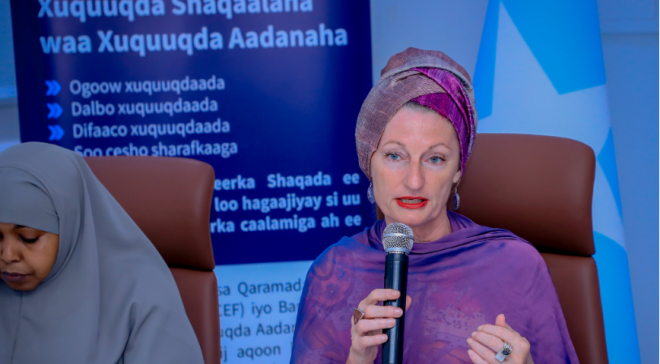
In addition, a specialised training session for women and young workers was held in Mogadishu to strengthen their understanding of the rights enshrined in the law and how young workers can claim their rights and resist exploitation and abuse while pursuing decent work. Further dedicated training for workers who are persons with disabilities took place in Mogadishu, marking the first time that persons with disabilities received sessions specifically tailored to their labour rights and inalienable right to inclusion and equal treatment.
Altogether, 218 workers were trained during the program. Of these, 98 were women and 120 were men. Youth workers accounted for 152 participants, while 66 were older workers. The programme ensured strong inclusion of workers with disabilities, with 53 persons with disabilities participating overall, including 22 women and 31 men.
To ensure continuity and deepen understanding beyond the training period, at least 2 participants from each training session were selected as peer educators, creating a network of trained worker educators who will continue raising awareness through FESTU’s 12 affiliated unions in workplaces and communities across the country.
To complement face-to-face training, FESTU developed and distributed more than 3,200 printed Information, Education and Communication materials in 2 Somali dialects, Maxaa Tiri and Maay. These materials explained workers’ rights and obligations under the Labour Code as well as the responsibilities of employers and government institutions in respecting and enforcing the law. The materials were disseminated during workshops and through union structures nationwide.
In parallel, 12 radio and television spots were produced and broadcast nationwide. Digital outreach through Facebook and X generated 206,227 engagements during October and November 2025, including 56,796 in October and 149,431 in November. The campaign also recorded 13,011 reactions over the same period. Combined broadcasting and digital dissemination reached an estimated audience of more than 2.3 million people nationwide.
The program placed a particular emphasis on equality and protection. Women represented 45 per cent of total participants. The specialised workshop for women and young workers addressed sexual violence and harassment prevention, reporting pathways and legal safeguards under the Labour Code, including references to the Violence and Harassment Convention, 2019 (No. 190) of the ILO, which Somalia has ratified and domesticated. The dedicated training for persons with disabilities focused on non-discrimination, reasonable accommodation, legal guarantees, occupational safety and health and access to complaint mechanisms.
As part of the broader campaign, the senior leadership of FESTU engaged the Federal Government of Somalia, particularly MOLSA and the Office of the Prime Minister, to advocate for enforcement of Labour Code provisions addressing sexual and gender-based violence in workplaces, especially to provide necessary protection for women workers. Government representatives committed to taking action and strengthening enforcement measures in line with the amended law.
“Through education, organisation and solidarity, we are turning this new law into a living instrument that protects rights at work, including protection against exploitation, ensuring fair wages, guaranteeing safety and promoting equality,” Omar said. “Labour rights are human rights and they must be respected in practice. A law adopted by the Federal Parliament of Somalia must translate into protection in every workplace.”
The nationwide labour rights education campaign comes as Somalia prepares for the Universal Periodic Review. FESTU remains committed to promoting decent work for youth and combating exploitation in line with Sustainable Development Goals 8 (decent work and economic growth) and 10 (reduced inequalities).
FESTU praised the UN Human Rights and Protection Group and the OHCHR Representative for helping the workers in Somalia and called the initiative an important move to implement the new Labour Code in Mogadishu and the Federal Member States, emphasising that open communication is essential for fair and stable working relationships in Somalia, where workers' basic rights are respected.