Somalia’s Currency Crisis Exposes Failures in Central Bank Leadership
-
 Staff Reporter GAROWE ONLINE
- Posted On 04-11-2026, 10:34PM
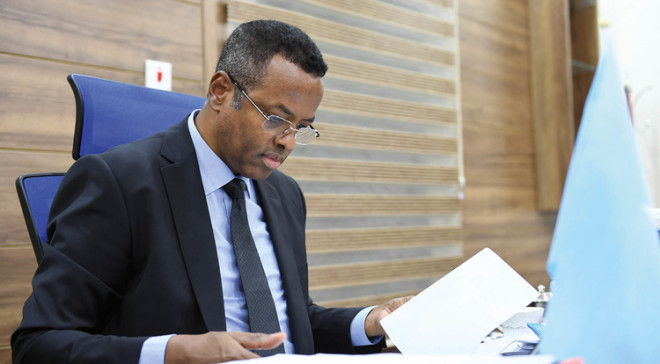
MOGADISHU, Somalia — Somalia’s failure to restore a functioning national currency more than three decades after the collapse of its monetary system is raising questions about the performance of the Central Bank and the results delivered under its leadership.
Since Governor Abdirahman Mohamed Abdullahi took office in April 2019, the Central Bank of Somalia (CBS) has pursued institutional restructuring, expanded banking supervision and introduced new financial regulations. Yet the country remains heavily dependent on the U.S. dollar, while the Somali shilling has not returned as a credible means of payment.
The gap between the institution’s administrative reforms and its central monetary responsibilities has become increasingly difficult to overlook. Despite more than seven years in office and continued support from international financial institutions, the central bank has yet to restore the national currency or provide a firm timetable for its reintroduction.
In an interview with African Business, Abdullahi described the difficulties he encountered when he assumed leadership of the institution, citing shortages of financial resources, technical expertise and qualified personnel.
He said the central bank previously had limited institutional capacity, operating mainly as a fiscal agent for the government and supervising five commercial banks. Most of its operations were conducted manually. He estimated that the scale of the initial institutional challenges stood at 85%.
Those constraints help explain the difficulties involved in rebuilding the institution. However, they also highlight the responsibility of its leadership to turn years of restructuring and international assistance into measurable results.
A national currency remains out of reach
The most significant unresolved challenge is Somalia’s continued inability to restore a functioning national currency.
The central bank has not issued new Somali shilling banknotes since 1991, leaving the economy heavily dollarized. Existing shilling notes are largely old or counterfeit, while the U.S. dollar dominates commercial transactions across much of the country.
The International Monetary Fund has identified the absence of a functioning national currency as a major constraint on Somalia’s monetary policy, limiting the central bank’s ability to influence domestic economic conditions.
Abdullahi acknowledged that widespread dollarization restricts the institution’s ability to conduct effective monetary policy, leaving it with limited influence over the country's financial environment.
The governor said the bank was working toward reintroducing the Somali shilling through a dual-currency arrangement under which the local currency and the U.S. dollar would circulate alongside each other.
The proposed system would operate through a currency board pegged to the dollar, with new shilling banknotes backed by sufficient foreign-exchange reserves.
However, the plan remains dependent on several conditions, including legislation establishing the currency board, amendments to the Central Bank Act, adequate reserve financing and arrangements for producing new banknotes.
Despite describing currency restoration as a major strategic priority, Abdullahi did not provide a specific date for the return of the shilling. He said the bank was prioritizing operational readiness rather than setting a launch deadline.
That leaves Somalia without a clear timetable for ending a monetary arrangement that has persisted for more than three decades. It also raises questions about how quickly the central bank intends to move from planning to implementation.
Banking expansion, limited financial inclusion
The central bank has pointed to the growth of its banking supervision as evidence of institutional progress.
According to Abdullahi, the number of commercial banks under its supervision has increased from five to 15, alongside the introduction of a risk-based regulatory framework.
But the expansion of regulated banks has yet to translate into widespread access to conventional banking services.
Figures cited by the governor show that approximately 87% of Somalis use mobile money, while only 19% have traditional bank accounts.
Mobile money has become essential to the Somali economy, allowing households and businesses to conduct transactions despite the absence of a functioning national currency. However, the figures also highlight the limited reach of conventional banking and the challenges facing the country's wider financial system.
The central bank's responsibility extends beyond licensing banks and strengthening supervision. It must also help create the conditions for broader financial inclusion, including access to savings, affordable credit and formal banking services.
The gap between regulatory expansion and access to financial services remains another measure of the work still facing the institution.
Dependence on international assistance
Building an institution capable of independently managing monetary policy remains another major challenge.
Abdullahi acknowledged that the central bank has relied heavily on the International Monetary Fund and World Bank for institutional restructuring, technical assistance and workforce development.
Such support has played an important role in rebuilding Somalia's financial institutions after decades of conflict and institutional collapse. However, international assistance cannot replace the need for domestic institutional capacity and effective implementation.
The central test for the central bank is whether it can develop the expertise, systems and financial resources needed to sustain reforms independently, enforce regulations and establish a credible monetary framework.
The governor also cited diaspora remittances, estimated at $3.2 billion annually and equivalent to about 22% of gross domestic product, as an opportunity to support domestic investment.
Despite the scale of these financial flows, Somalia continues to face challenges in directing more resources into productive investment through formal financial institutions.
The leadership question
Somalia's completion of the Heavily Indebted Poor Countries debt relief programme and improvements in financial regulation represent important developments in the country's economic recovery. But these achievements have not resolved the central bank's most fundamental monetary challenge.
The institution's performance cannot be measured solely by the number of commercial banks it supervises, the regulations it introduces or the international partnerships it maintains. Its central responsibilities include safeguarding financial stability, developing an effective monetary policy framework and restoring public confidence in the national currency.
For Abdullahi, who has led the institution since April 2019, the continued absence of a functioning Somali shilling remains a major unresolved challenge after more than seven years in office.
The governor has argued that currency restoration should not be rushed, insisting that adequate reserves, legislation and institutional safeguards must be in place before new banknotes are issued. That caution reflects the risks of introducing an unstable currency into an already fragile economy.
However, the need for safeguards does not remove the importance of clear targets, measurable progress and accountability for implementation. Without a firm timetable, it remains difficult to assess when the proposed currency framework will become operational or how the central bank intends to overcome the obstacles delaying its introduction.
Ultimately, Somalia's prolonged currency crisis highlights the gap between institutional reform and the delivery of the central bank's core responsibilities. Despite years of restructuring and international support, the country remains without a functioning national currency, with monetary policy constrained by its dependence on the U.S. dollar.
For the central bank's leadership, restoring the Somali shilling and rebuilding monetary independence remain the most consequential tests of its record. Until tangible progress is made, the continued absence of a credible national currency will remain a stark measure of the institution's unfinished reforms.
GAROWE ONLINE