Opinion: Somalia Between Ethiopia, Egypt and Eritrea
-
 Abdirahman Jeylani Mohamed
- Posted On 03-10-2026, 11:57AM
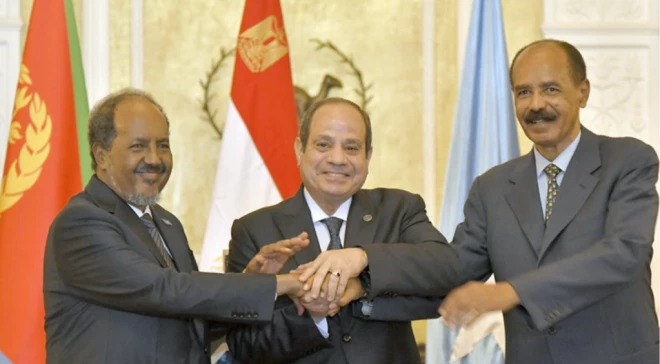
Somalia has spent the past several years trying to reposition itself from an arena of regional competition into an increasingly consequential geopolitical actor.
The renewed crisis between Ethiopia, Eritrea and Egypt now presents one of the clearest tests of whether Mogadishu can sustain that ambition.
The fighting in northern Ethiopia is no longer merely an Ethiopian domestic affair. The deterioration of relations between Addis Ababa and Asmara, Egypt’s strategic rivalry with Ethiopia, Sudan’s continuing war, and the competition over Red Sea access are creating a regional security environment in which developments in one theatre can rapidly affect another.
For Somalia, the central question is not whether to take sides in Ethiopia's conflict. It is whether Mogadishu can remain sufficiently engaged to protect its interests while avoiding becoming entangled in a war whose consequences it cannot control.
The answer will require something Somalia has historically struggled to maintain: strategic consistency.
Ethiopia’s instability presents Somalia with both risks and opportunities
Ethiopia is too important to Somalia to ignore and too powerful to confront casually.
The two countries share a long border, extensive economic and security ties, and a complicated political history. Ethiopian forces have also played an important role in Somalia's security architecture, including through the African Union Support and Stabilization Mission in Somalia.
Any significant deterioration inside Ethiopia therefore has immediate implications for Somalia.
If Addis Ababa is forced to redirect military resources toward Tigray, Amhara, Afar or other internal fronts, Ethiopia's ability to sustain deployments outside its borders could change. For Somalia, that raises questions about the future configuration of AUSSOM, border security and counterinsurgency operations.
Yet Ethiopian instability would not necessarily benefit Somalia.
A weakened Ethiopian state could mean greater instability along the border, refugee movements, illicit arms flows, disruption of commerce and increased opportunities for Al-Shabaab.
Mogadishu should therefore resist a potentially seductive but dangerous assumption: that Ethiopia's strategic difficulties automatically strengthen Somalia's position.
They do not.
The Eritrea factor changes the equation
The deterioration between Ethiopia and Eritrea is particularly significant.
For years, the Horn's strategic balance has been shaped by the relationship between Addis Ababa and Asmara. The two countries' rapprochement in 2018 temporarily reduced one of the region's most consequential rivalries.
That period now appears increasingly fragile.
The latest diplomatic rupture between Ethiopia and Eritrea raises the possibility that the Horn could once again develop competing security blocs.
For Somalia, this presents a delicate diplomatic problem.
Mogadishu has interests in maintaining constructive relations with Eritrea while simultaneously preserving its strategic partnership with Ethiopia. It also has growing defence cooperation with Egypt and Türkiye.
A policy that places Somalia firmly in one regional camp would therefore carry substantial costs.
The more sustainable approach is to preserve multiple diplomatic channels simultaneously.
Somalia should be able to speak to Addis Ababa, Asmara and Cairo without allowing any of them to determine its foreign policy.
Egypt is a partner, but Somalia should not inherit Egypt’s conflict
Egypt's growing engagement with Somalia is understandable from Cairo's perspective.
The Nile dispute with Ethiopia, the instability in Sudan and the strategic importance of the Red Sea have created incentives for Egypt to deepen relations with countries on Ethiopia's eastern flank.
For Somalia, Egyptian military cooperation can provide useful capabilities, training and institutional support.
But the distinction between Somali-Egyptian cooperation and Egyptian-Ethiopian rivalry must remain clear.
Somalia should not allow its territory, military infrastructure or diplomatic relationships to become instruments in the dispute over the Grand Ethiopian Renaissance Dam.
The same principle should apply to every external partner.
Somalia's partnerships should strengthen Somali state capacity—not transform Somalia into a platform for someone else's regional strategy.
The Ankara framework is more important than ever
The 2024 Ankara Declaration offers Somalia an important diplomatic framework.
The agreement helped de-escalate the confrontation that followed Ethiopia's maritime-access understanding with Somaliland. Its central logic—that Ethiopia can pursue reliable commercial access to the sea while respecting Somalia's sovereignty and territorial integrity—remains relevant.
The renewed Ethiopian crisis makes that framework more, not less, important.
Ethiopia's strategic need for maritime access is unlikely to disappear because of internal political instability. If anything, strategic uncertainty could make access to the sea more important to Ethiopian policymakers.
Somalia therefore has an opportunity to transform a potential source of confrontation into a long-term economic relationship.
But this requires discipline.
Mogadishu should distinguish between commercial access and sovereign control.
Ethiopia can have an economic interest in Somali maritime infrastructure without acquiring sovereign rights over Somali territory.
That principle should remain at the centre of Somalia's policy.
Somalia should prepare for an Ethiopian military redeployment
One of the most immediate practical consequences of a wider Ethiopian conflict could be a change in Ethiopia's external military commitments.
If Addis Ababa requires additional forces at home, it could reassess its deployments in Somalia.
Mogadishu should not wait for such a decision to occur before considering its consequences.
The Federal Government should work with the African Union and AUSSOM partners on contingency planning for different scenarios, including a reduction or reconfiguration of Ethiopian forces.
This does not mean assuming that Ethiopia will withdraw.
It means recognising that Somali security policy should not depend on assumptions about another country's domestic military requirements.
The long-term objective should be a Somali security architecture capable of functioning regardless of which external partner is able or willing to contribute troops.
The maritime dimension may ultimately matter most
The geopolitical significance of Somalia is increasingly maritime.
The country's coastline sits alongside the Gulf of Aden and near one of the world's most important maritime corridors.
The renewed instability around Ethiopia and Eritrea therefore cannot be separated from the broader contest over the Red Sea.
For Somalia, this creates both vulnerability and leverage.
Its coastline can attract investment, strengthen trade and generate strategic partnerships. But it can also attract foreign military competition, illicit networks and geopolitical pressure.
The appropriate response is not to close Somalia's coastline to foreign partners.
It is to ensure that Somalia controls the terms of engagement.
That means strengthening the Somali Navy and Coast Guard, developing maritime surveillance, improving port governance and building the institutional capacity necessary to manage foreign security and commercial agreements.
The greatest danger is strategic fragmentation
Somalia's foreign policy is becoming increasingly diversified.
Türkiye is an important defence partner. Egypt has expanded military cooperation. Ethiopia remains an essential neighbour and security actor. Gulf countries possess substantial economic and strategic interests. The United States and European countries remain important security and development partners.
There is nothing inherently contradictory about maintaining all of these relationships.
The contradiction emerges only when external partnerships begin pulling Somali policy in incompatible directions.
The solution is not to choose one partner.
It is to develop a Somali strategic doctrine that determines what every partnership is intended to achieve.
Such a doctrine would establish several principles:
Somalia will not participate in Ethiopia's internal war.
Somalia will oppose violations of its sovereignty and territorial integrity regardless of the actor involved.
Somalia will support peaceful regional dialogue.
Somalia will welcome commercial and security partnerships that strengthen national institutions.
Somalia will not permit its territory to become a platform for another state's military confrontation.
And, critically, Somalia will maintain diplomatic relations with competing regional powers simultaneously.
The strategic choice
Mogadishu is unlikely to have the ability to influence the outcome of Ethiopia's internal conflict directly.
It does, however, have considerable influence over whether Somalia becomes collateral damage from it. That distinction should guide policy.
The objective should not be to exploit Ethiopia's instability, nor to defend every decision taken by Addis Ababa.
It should be to preserve Somalia's strategic autonomy while preventing instability from crossing the border.
That requires a foreign policy based on non-alignment without neutrality toward threats, engagement without entanglement, and partnership without dependency.
The Horn of Africa is entering another period in which borders, alliances and security calculations are likely to shift quickly.
Somalia cannot determine what happens in Ethiopia. It can determine how Somalia responds. And that may prove to be the more consequential strategic decision.
The author is Abdirahman Jeylani Mohamed, a Somali journalist, communications specialist and foreign policy commentator based in Mogadishu, Somalia. You can reach out to him; jaylaanijr@gmail.com