Editorial | Garowe Online: A Call for Restraint, Responsibility, and Regional Solidarity
-
 GAROWE ONLINE
- Posted On 12-01-2026, 08:39PM
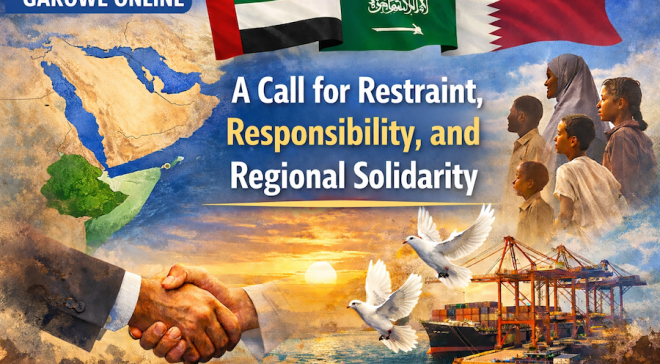
EDITORIAL | The Somali Federal Government’s decision to sever ties with the United Arab Emirates comes at a moment of acute national vulnerability. Somalia is still emerging from more than three and a half decades of conflict, displacement, and institutional fragility, with millions of its citizens dependent—directly and indirectly—on regional economic and humanitarian links for their livelihoods and survival.
In this context, Garowe Online calls on the United Arab Emirates to exercise restraint and avoid retaliatory measures that would further burden the Somali people. Humanitarian considerations must remain paramount. Somalia’s current political and economic conditions do not allow for additional external shocks, particularly those that could disrupt trade, remittances, employment, or humanitarian assistance relied upon by ordinary citizens.
Economic ties between Somalia and the UAE are deep and long-standing. In 2024, bilateral trade exceeded US$2.2 billion, underscoring the central role the UAE—especially Dubai—plays as a commercial gateway for Somali traders, businesses, and financial institutions. Investments in the ports of Bosaso and Berbera, valued in the hundreds of millions of dollars, have contributed to employment, logistics capacity, and regional connectivity. These investments should be recognized for their practical value to the Somali people, regardless of shifting political positions.
Somalia’s partners in the Gulf—particularly Saudi Arabia and Qatar—are also urged not to draw Somalia into wider regional rivalries or pressure it into becoming a proxy arena for disputes among larger powers. Somalia is a neighboring country, a Muslim nation, and a member of the Arab League. Its people seek partnership, not polarization. Differences among brotherly Gulf states should be resolved through dialogue, not projected onto fragile states least able to absorb the consequences.
It is equally concerning to see political figures celebrating this diplomatic rupture while ignoring the human cost. Millions of Somalis rely on Gulf-linked trade, employment, remittances, and services. Applauding actions that place these lifelines at risk reflects a troubling disregard for the realities faced by ordinary citizens.
Somalia today needs help, understanding, and stability, not entanglement in international or regional conflicts. The Federal Government, whose current term is set to expire in the coming months, would best serve the country by focusing on internal political agreement, governance, and national reconciliation. Protecting sovereignty ultimately requires political consensus that unites the Somali people and strengthens institutions from within.
This is a moment for restraint on all sides. Somalia’s neighbors and partners should act with solidarity and compassion, while Somali leaders concentrate on the urgent task of rebuilding a state that delivers peace, opportunity, and dignity to its people.
GAROWE ONLINE