After Israel’s Somaliland Decision, Somalia’s Political Fault Lines Deepen
-
 GAROWE ONLINE
- Posted On 01-01-2026, 08:27PM

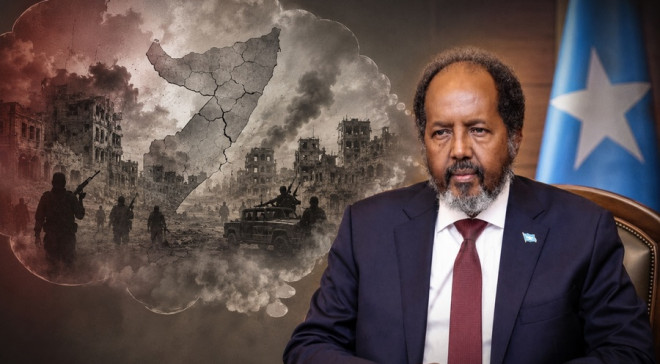
EDITORIAL | Somalia’s political stress did not begin with Israel’s recognition of Somaliland, but that decision has exposed the depth of a system already under strain. What followed was not a unified national response, but a revealing fragmentation—one that underscores how brittle the country’s federal compact has become.
Most striking has been the silence. Puntland and Jubaland, two of the most consequential federal member states, have refrained from issuing clear public positions on the matter. In a healthy federal system, silence can sometimes signal coordination behind closed doors. In Somalia’s case, it reads differently: as an indication of a fractured political order in which the center no longer commands either confidence or consensus.
The absence of clear positions from these states is not accidental. It reflects a deeper reality: the Federal Government lacks the political authority, trust, and institutional coherence required to rally the federation around a shared national stance. When the stakes involve sovereignty and territorial integrity, silence from key stakeholders becomes a statement in itself.
The Federal Government’s response has only reinforced this impression. Rather than treating national unity as a shared constitutional obligation requiring inclusion and restraint, the issue has increasingly been politicized—used to justify contested constitutional changes, disputed electoral processes in Mogadishu, and a broader effort to consolidate authority as the government approaches the end of its mandate.
This approach has proven counterproductive. Unity, when used as a political tool rather than upheld as a constitutional principle, loses its unifying force. It becomes divisive, encouraging federal member states to withdraw into caution or quiet disengagement rather than alignment.
International confidence has also suffered. Constitutional amendments and local council elections conducted in Mogadishu without broad domestic agreement or international recognition have raised questions about both legality and intent. In global politics, legitimacy matters as much as law, and Somalia is now struggling with both.
As with many fragile states, Somalia is learning that global politics does not pause. When a country is consumed by internal disputes, leadership uncertainty, and federal dissonance, external actors adjust accordingly. Israel’s recognition of Somaliland came at precisely such a moment, when Somalia’s political energy was absorbed by arguments over authority, timelines, and rules.
At the same time, divisions within the Federal Government itself have become increasingly visible. Politicians from Somaliland holding federal positions have openly defended the political claims of their regions, while officials from other federal member states, operating from Mogadishu, regularly criticize their own home regions in public forums. The result is not cohesion, but a fragmented national narrative.
The deeper issue, however, is constitutional as much as political. Somalia’s constitution assigns the Federal Government clear responsibility for preserving national unity and defending the country’s sovereignty. What is lacking is unity among Somalis themselves. Puntland and Jubaland, in particular, increasingly view the language of national unity and the authority exercised in the name of the Somali state as benefiting a narrow political circle concentrated around the capital. Within the current administration, some officials are perceived as treating these states not as equal partners in the federation, but as distant or secondary actors.
This perception has widened mistrust and weakened the sense of shared ownership over the national project. The question Somalia now faces is not simply how to respond to Israel’s recognition of Somaliland. It is whether the country’s political leadership can rebuild trust, restore balance within the federal system, and articulate a vision of unity that is credible to its member states, convincing to its citizens, and respected internationally.
If silence persists, if unity continues to be politicized rather than grounded in consensus, and if authority is pursued without inclusion, the consequences will extend far beyond this moment. In international politics, vacuums rarely remain empty. They are filled—sometimes quietly, sometimes decisively—by forces that move faster than states still debating who truly speaks for the nation.
GAROWE ONLINE