AU Intensifies Diplomatic Push to End Conflicts in Sudan and Eastern DRC, Says Bankole Adeoye
-
 News
News
- Posted On 17-02-2026, 01:20PM
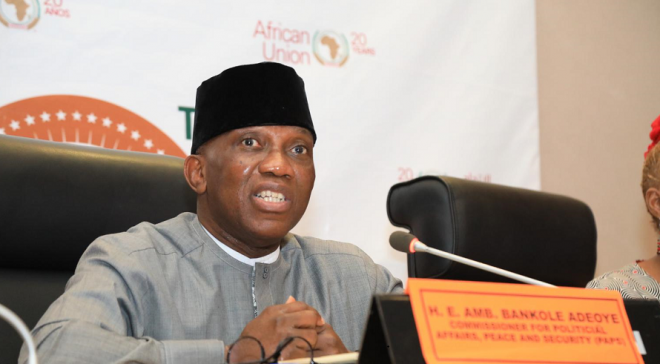
The African Union has stepped up efforts to secure ceasefires in Sudan and the eastern Democratic Republic of Congo, with Commissioner for Political Affairs, Peace and Security, Ambassador Bankole Adeoye, outlining a renewed continental strategy aimed at ending protracted conflicts and restoring stability.
Briefing reporters after the 39th Ordinary Session of the Assembly of Heads of State and Government, Ambassador Adeoye said the Union’s leadership had reaffirmed its commitment to African-led mediation backed by coordinated international support. He described the current moment as critical, with rising regional instability and growing pressure on multilateral systems demanding stronger continental cohesion.
In eastern DRC, he confirmed that President Faure Gnassingbé of Togo, appointed as AU mediator, had presented an updated report on diplomatic progress. The AU, working alongside the East African Community and the Southern African Development Community, is pressing for an immediate and lasting ceasefire. Eight agreements reached through the Doha and Washington tracks provide a framework, he said, but implementation and compliance by all armed actors remain essential.
The Commissioner urged all parties, including the M23, to halt fighting and engage in an inclusive inter-Congolese dialogue. Ending civilian suffering and rebuilding trust between stakeholders, he noted, are central to achieving durable peace. Eastern DRC remains at the forefront of the AU’s peace agenda under its wider goal of silencing the guns across the continent.
Turning to Sudan, Ambassador Adeoye described the conflict as catastrophic in humanitarian terms and reaffirmed the AU’s roadmap, which prioritizes a permanent ceasefire, unhindered humanitarian access, and an inclusive political process led by civilians. He emphasized coordination with IGAD, the United Nations, the League of Arab States, and the European Union, saying diplomatic alignment is key to sustaining pressure on the warring parties.
The AU Peace and Security Council, which met at ministerial level ahead of the summit, reiterated its support for a comprehensive and unconditional ceasefire. While long-term stabilization mechanisms are being examined, the Commissioner made clear that the immediate task is to end hostilities and open space for political settlement.
Addressing broader governance concerns, Ambassador Adeoye restated the Union’s zero-tolerance stance on unconstitutional changes of government. Six member states remain suspended, yet engagement continues to facilitate credible transitions back to constitutional order.
On global reform, he underscored Africa’s call for restructuring the United Nations Security Council in line with the Ezulwini Consensus, arguing that Africa’s 54 member states deserve permanent representation, including veto rights, in a body that shapes global peace and security decisions.
Throughout his remarks, the Commissioner linked current peace efforts to the African Union’s Agenda 2063 vision. Despite global uncertainty and shifting geopolitical alliances, he said Africa is determined to act collectively, defend democratic norms, and pursue sustainable peace grounded in African leadership and cooperation.