Op-Ed: Law on the Page, Fragility on the Ground: Somalia’s Constitutional Dilemma
-
 Abdirahman Jeylani Mohamed
- Posted On 07-03-2026, 07:13PM
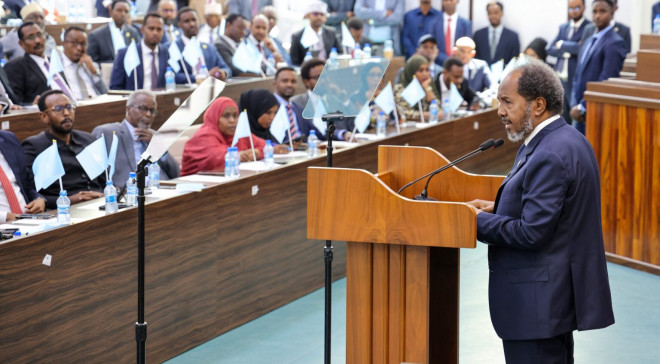
Somalia today stands at a paradoxical juncture. A nation long defined by fragmentation, war, and contested legitimacy now witnesses parliamentarians celebrating constitutional amendments as proof of a “fully-fledged state.” Yet this moment, emblematic though it is, embodies both progress and illusion. It is neither a final triumph nor a return to the chaos of the past; it is a reflection of the tenuous balance between aspiration and reality, between the symbolism of law and the lived complexities of governance.
The narrative that Somalia has definitively transitioned from a provisional polity to a consolidated state risks oversimplification. The 2012 constitution, though a landmark in post-conflict state-building, was deliberately provisional, designed to accommodate regional autonomy, nascent institutions, and the fluid dynamics of federal governance. To frame recent amendments as the culmination of decades of transition is to underestimate the intricate negotiations, compromises, and regional divergences that continue to define Somali politics. Constitutional text is necessary but insufficient; it provides a scaffold, not the full architecture of a functioning state.
Recent parliamentary amendments do represent meaningful progress. They demonstrate a capacity for procedural negotiation, the willingness of Somali legislators to engage with complex constitutional issues, and a formal assertion of governance over legal frameworks that were long provisional. These are important milestones, indicative of a political system attempting to mature, even under persistent pressures. They also send a signal to international partners that Somalia is striving to stabilise its institutions, create predictable governance, and adhere to frameworks that allow for federal participation.
Yet the path toward complete statehood is neither linear nor uncontested. Key federal member states, including Puntland and Jubbaland, were either marginalised or expressed dissent, underscoring the delicate federal equilibrium that remains fragile. True federalism requires not only the authority of central institutions but also the consent and cooperation of regional actors. When these actors are absent or disengaged, even well-intentioned reforms risk being perceived as unilateral, potentially exacerbating tensions rather than resolving them. In parallel, Somaliland continues to function as a de facto self-governing entity with entrenched domestic support for independence, highlighting the enduring territorial and political ambiguities that a centralised narrative may obscure.
Institutional capacity, while improving, remains uneven. Parliament functions under the persistent pressures of factionalism, patronage, and occasional procedural irregularities. The judiciary, too, faces challenges asserting independence in politically charged disputes. Governance is therefore still as much a product of negotiation, power-sharing, and informal authority as it is of codified law. International observers rightly note that a parliament-centred achievement does not automatically equate to a consolidated or universally recognised state. Recognition is earned as much by effective administration, territorial coherence, and public trust as by legislative milestones.
The geopolitical context further complicates this narrative. Somalia’s sovereignty is not only a domestic concern but also a regional and international one. Foreign governments’ engagement with autonomous or breakaway entities signals that those questions of territorial integrity remain alive on the global stage. Statehood is validated not only by internal political processes but by the perception of external actors, who monitor both institutional stability and the capacity to project authority across the nation’s claimed territory.
The truth is that Somalia has made tangible progress without yet completing the consolidation process. Constitutional amendments, procedural achievements, and incremental federal agreements constitute genuine milestones. Yet the country continues to navigate an environment defined by contested authority, unresolved regional disagreements, and ongoing security and governance challenges. The milestone is real, but it is not definitive.
Somalia’s journey, therefore, must be understood as one of cautious optimism. Progress exists alongside fragility, hope alongside uncertainty, and achievements alongside enduring structural gaps. A balanced perspective recognises the significance of recent developments while remaining candid about the work that remains: fostering genuine inclusion across federal states, building resilient institutions capable of sustaining authority beyond Mogadishu, and translating symbolic legal reforms into tangible governance outcomes.
In the end, Somalia is neither fully fledged nor a mere provisional entity. It is a state in the making, one that demands both recognition of its strides and a sober assessment of its enduring challenges. Celebrating milestones without acknowledging fragility risks overstatement; ignoring achievements risks cynicism. The path forward lies in sustaining incremental progress while confronting the structural realities that define the Somali state today.
The Author is Abdirahman Jeylani, a Somali journalist based in Mogadishu, a foreign policy commentator and communications specialist.