OP-ED: Somalia’s 2026 Transition: Steering Through a Proxy Election Before National Collapse
-
 Abdirahman Jeylani Mohamed
- Posted On 15-02-2026, 09:39AM
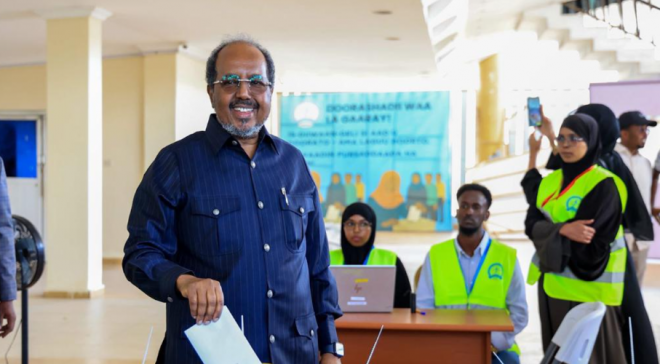
Somalia’s march toward its 2026 presidential election is no longer simply a domestic political transition. What began as a fraught negotiation over electoral models and constitutional legitimacy is set to become deeply entangled in a widening geopolitical contest.
With no agreement on the mechanics of the vote and the clock rapidly running down, internal political deadlock is intersecting with external power plays — and the result could reshape Somalia’s future far beyond who sits in Villa Somalia.
Three months out from the national vote, there remains no clear roadmap for how Somalia will elect its next president. Efforts to move toward one-person, one-vote elections — a historic ambition after decades of clan-based indirect systems — have collided with entrenched political elite interests and constitutional ambiguity.
The Suspension of Somali Politics
Talks between the federal government and opposition leaders have repeatedly stalled, and opposition summits have warned that without agreement, political processes risk splintering into parallel, competing governance claims that could trigger instability and even violence.
Recent political gatherings of key state leaders underscored that the mandates of parliament and the presidency are due to expire in May 2026, and that any attempt to extend terms unilaterally would deepen national fragmentation and erode fragile institutional legitimacy.
A precedent of deadlock and competing national projects looms large in political memory, raising the spectre of rival political authorities claiming authority if consensus fails to be reached on an electoral framework.
These domestic tensions are not occurring in a vacuum. Decades of international investment in Somali state-building now risk unraveling in a context where political disputes intersect with external strategic interests and rivalries.
External Stakes in a Fragile State
In late 2025, the diplomatic landscape of the Horn of Africa was shaken by Israel’s decision to formally recognize the self-declared Republic of Somaliland — a territory that declared independence from Somalia in 1991, yet remained unrecognized by the global community until that moment.
While Israeli officials framed the move as a security calculus tied to Red Sea dynamics and threats emanating from Yemen, the recognition reverberated far beyond northern Somalia. It challenged long-standing norms of territorial sovereignty in the region, prompting widespread condemnation from countries across the Middle East and Africa and reinforcing Somali resistance to secessionist claims. For many Somali nationalists, the recognition was seen not merely as a geopolitical manoeuvre but as an affront to Somalia’s territorial integrity.
This episode has contributed to a more charged environment in Mogadishu. In response, Somalia has taken steps to fortify diplomatic and security partnerships. Most recently, Mogadishu signed a defence pact with Saudi Arabia, deepening ties with a Gulf power that has increasingly asserted its own interests in the wider Red Sea and Horn theatre. These developments reflect shifting alliances as Gulf rivalries, particularly the competition between Saudi Arabia and the United Arab Emirates, seep into East African politics, pressuring regional actors to align with competing blocs and strategic visions.
At the same time, Turkey continues to be deeply embedded in Somalia’s security architecture. Turkish military involvement in Somalia has recently entered a more kinetic phase, with Turkish F-16s deployed to Mogadishu and ground units participating directly in operations against insurgents. This marked departure from Turkey’s earlier advisory and training posture signals an escalation in its strategic footprint.
Ankara has invested heavily in Somali infrastructure, naval cooperation, and counter-insurgency training over the past decade; its deep involvement means Turkey is not a distant observer but a central actor in Somalia’s security calculus. Such foreign military engagement inevitably becomes politically charged in an environment where state institutions are contested.
A Geopolitical Contest on Fragile Ground
The intersection of Somalia’s domestic impasse and external power competition has created a new pattern of geopolitical feedback loops. As rival foreign interests stake claims — whether through military presence, diplomatic recognition, or defense partnerships — Somalia’s internal political actors find themselves navigating an increasingly complex set of incentives and pressures.
Israel’s recognition of Somaliland was widely interpreted in international policy circles as a strategic move to secure influence along critical Red Sea routes in the face of threats from Yemen. For Ankara, the move was an unwelcome intrusion into a sphere where it has sought to project influence for years. Washington, Riyadh, Cairo, and other capitals are also recalibrating their approaches, balancing support for Somali sovereignty with broader regional strategies. This conflation of local political processes with regional power dynamics risks turning Somalia’s election into a proxy arena where external actors test limits and assert influence.
Somalia’s internal political contest is at a dangerous crossroads: if agreement on an electoral framework collapse entirely, the likelihood of parallel political processes — rival electoral timelines, competing claims to authority, and potentially competing security forces — will surge. In such a scenario, external actors could find themselves drawn deeper into the fray, aligning with factions that best reflect their strategic interests. Power, rather than legitimacy, could end up determining outcomes.
The Danger of a Proxy Election
It is no longer sufficient to analyze Somalia’s electoral dispute in isolation. The dynamics of regional rivalry — between Gulf powers, between Israel and regional Middle Eastern states, and among global actors seeking footholds in the Red Sea corridor — have now become intertwined with domestic Somali political trajectories. Where once international engagement focused on mediation and capacity building, foreign policy today is as much about positioning and influence.
If opposition forces feel increasingly marginalized by a unilateral electoral push, the risk of institutionally backed parallel processes grows. Should national consensus fail and factions begin to mobilize along political or regional lines, the election could harden into a geopolitical proxy contest. At that point, debates over constitutional interpretation and polling modalities could give way to struggles over alliance commitments and the backing of external patrons.
Somalia’s election is no longer just about who leads the country after May 2026. It is about whether Somalia’s fragile political settlement can withstand the pressures of both internal contention and external competition.
The danger is that, without a credible, inclusive agreement on electoral processes, the 2026 election itself may instead become the moment when Somalia’s sovereignty is contested not only by its own political class, but by strategic actors with competing visions for the Horn of Africa’s future.
The author is Abdirahman Jeylani, a journalist based in Mogadishu, a communications specialist and foreign policy commentator. You can reach out to him: canaanbinu55@gmail.com