Op-Ed: Somalia’s Election Standoff Is a Referendum on Its Post-Transition State
-
 Abdirahman Jeylani Mohamed
- Posted On 21-12-2025, 11:06AM
Somalia’s latest political confrontation is not merely another dispute over timelines, term limits, or electoral modalities. It is a stress test of the country’s post-debt-relief political contract—and, by extension, of the international state-building model that has sustained Mogadishu for more than a decade.
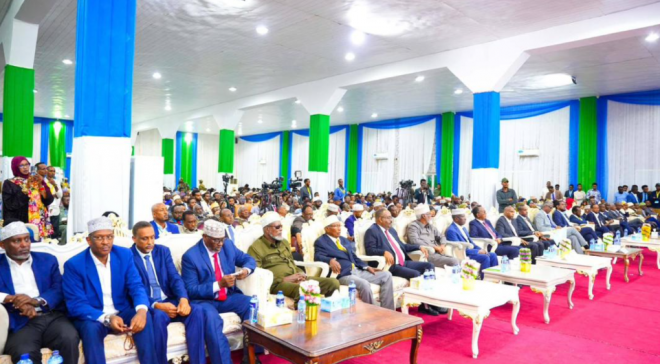
The opposition-aligned National Consultation Conference, which concluded this week in Kismayo, has accused President Hassan Sheikh Mohamud of constitutional violations, governance failures, and abandoning the fight against Al-Shabaab. Its communiqué warns that unilateral decision-making and delayed elections risk “political collapse, insecurity, and economic breakdown.” More striking than the language, however, is the breadth of the coalition delivering the message and the timing of its ultimatum.
The gathering brought together Puntland and Jubaland presidents Said Abdullahi Deni and Ahmed Mohamed Islam (Madobe); former President Sharif Sheikh Ahmed; former prime ministers Abdi Farah Shirdoon, Hassan Ali Khaire, and Mohamed Hussein Roble; sitting members of parliament; and multiple presidential aspirants. Such ideological and regional diversity rarely converges in Somali politics unless the participants believe a structural red line is being crossed.
At issue is not only whether elections will occur on time, but whether Somalia’s post-transition order—formalized after the end of the provisional era, reinforced by debt relief in 2023, and underwritten by sustained donor engagement—can survive an increasingly centralized presidency.
The opposition’s rejection of unilateral constitutional amendments speaks to a deeper anxiety: that Somalia’s federal system is being hollowed out through legal and procedural shortcuts rather than formal renegotiation. By declaring all presidentially driven constitutional changes “null and void” and reasserting the supremacy of the 2012 Provisional Constitution, the communiqué challenges not just the President’s authority but the method by which power is being accumulated in Mogadishu.
This matters because Somalia’s political equilibrium has always rested less on formal institutions than on negotiated consent. Every major political advance since 2000—from the federal charter to indirect elections—has been sustained by elite bargains rather than enforcement mechanisms. When those bargains fracture, the state does not fail abruptly; it fragments quietly, with parallel processes replacing national ones.
The opposition’s categorical rejection of term extensions beyond April and May 2026 reflects this fear. Somalia’s political class remembers too well how “technical delays” have historically become open-ended power grabs. In a country without an independent constitutional court capable of arbitrating such disputes, legitimacy is binary: either elections are agreed upon in advance, or they are contested by default.
The one-month ultimatum issued to President Hassan Sheikh Mohamud—giving him until January 20, 2026, to convene all stakeholders around an inclusive electoral framework—is therefore less a threat than a deadline for salvaging elite consensus. The warning of a “parallel electoral process” should not be read as posturing. Somalia has pursued parallel tracks before, and each time they have weakened federal cohesion, emboldened spoilers, and distracted security forces at critical moments.
The Banadir question further complicates matters. The opposition’s rejection of the Mogadishu election process on constitutional grounds highlights a long-deferred issue in Somali governance: the capital’s ambiguous legal status. Successive administrations have avoided resolving Banadir’s representation because doing so would redistribute political power. Yet proceeding with elections there without consensus risks delegitimizing the entire national process.
President Hassan Sheikh Mohamud’s response has so far been cautious. Speaking at a public event, he dismissed the Kismayo meeting but signaled openness to dialogue should the opposition present a unified position. That formulation places the burden back on his rivals, even as their communiqué suggests rare alignment. Former President Mohamed Abdullahi Mohamed (Farmaajo) did not attend the talks but is reported to broadly agree with their conclusions—an indication that the opposition’s center of gravity may be larger than it appears.
For international partners, this confrontation presents an uncomfortable dilemma. Donors and security allies have invested heavily in portraying Somalia as a country moving beyond perpetual transition—evidenced by debt relief, normalized financial relations, and the planned drawdown of ATMIS. Yet those gains rest on political predictability. A disputed or fragmented election would undermine not only Somalia’s domestic legitimacy but also the assumptions underpinning international engagement.
The deeper question, then, is whether Somalia’s post-transition state can function without constant external arbitration. If every major political disagreement requires international mediation to prevent collapse, the model itself remains incomplete.
What is unfolding is not simply an opposition challenge to an incumbent president. It is a referendum on whether Somalia’s leaders can internalize the rules of political competition—or whether power will continue to be negotiated at the edge of crisis. The coming weeks will reveal whether consensus politics can be restored, or whether Somalia is drifting toward another prolonged electoral impasse—this time with far more to lose.
The author is Abdirahman Jeylani Mohamed, a Somali journalist based in Mogadishu, a foreign policy commentator and communications specialist